140‐Day QuickBooks Trial Software
Installation Guide
This guide will help you install the 140‐day trial version of QuickBooks that is associated with your textbook. Depending on your textbook, the software may be available via digital download or DVD. This guide includes instructions for installing the software using both methods. Also included are instructions for toggling to the Pro edition of the software, which is necessary for some users. Be sure to check out the Common Questions section at the end of this guide.
Contents |
|
| Note! Your QuickBooks trial software is intended for use on a Windows‐based PC. The | |
software cannot be installed mobile devices using the iOS or Android operating system. |
|
Please see this page for more information on system requirements to install QuickBooks. |
Installing QuickBooks – Digital Download
If your trial version of QuickBooks is provided via digital download, you will access the software from the Intuit website.
Before you get started, make sure you have your license number and product number handy.
15‐digit license number: ___ ___ ___ ___ – ___ ___ ___ ___ – ___ ___ ___ ___ – ___ ___ ___
6‐digit product number: (QuickBooks 2014) 602 – 834 (QuickBooks 2015) 503 – 154
1.Close all running programs, including antivirus programs.
Remember to restart your antivirus program(s) after the software installation is complete.
2.Open a web browser and navigate to http://quickbooks.com/download.
These instructions use Internet Explorer. Different web browsers may behave differently.
3.Click the QuickBooks Accountant link for your version of QuickBooks.
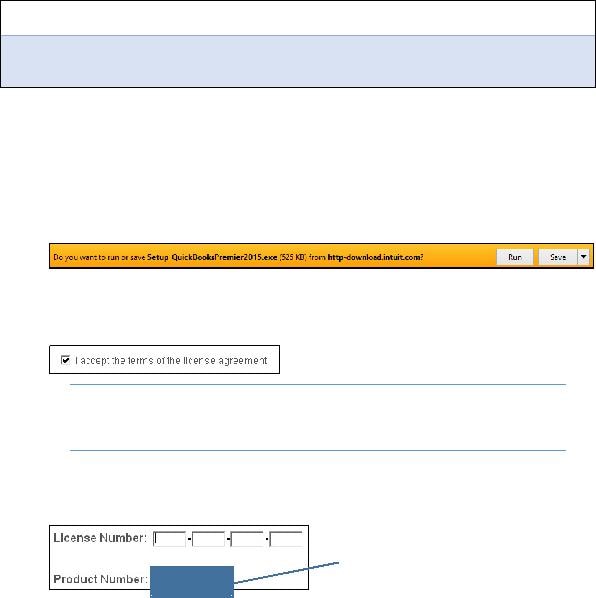
4.Choose the Run option in the download bar, and then choose Yes in the dialog box that appears.
Continue with the next step after the download completes.
5.Click Next in the wizard screen, and then click Next in the Intuit QuickBooks Installer window.
6.Click the checkbox to accept the terms of the license agreement; click Next.
Tip! If desired, use the Print link at the top‐right corner
of the window to print the License Agreement for your records.
7.Ensure that the Express (recommended) installation type is selected; click Next.
The Express installation will place QuickBooks in the default location on your computer.
8.Type your license number and product number in the provided boxes; click Next.
For QuickBooks 2014, use 602‐834.
For QuickBooks 2015, use 503‐153.
9.Click Install.
The installation can take time, so be patient!
10.Click Open QuickBooks in the screen that appears after the installation is complete.
11.If a notice regarding how QuickBooks uses your Internet connection appears, click OK.
The QuickBooks trial software is now installed on your computer.
12.Toggle to the Pro edition of the software, if necessary for your course.
Spoofer Source Code Info
It is critical to note that while spoofing code is a legitimate subject for Cybersecurity Education , its application outside of controlled, authorized environments can be illegal. Developers often share source code on platforms like GitHub for transparency and educational peer review.
This information is intended solely for educational purposes and authorized network security assessments. How to Detect and Prevent ARP Spoofing
The source code for a Spoofer tool typically involves the following steps:
Altering unique hardware identifiers (like disk serial numbers or MAC addresses) to circumvent "Hardware ID" bans in online games. Spoofer Source Code
Address Resolution Protocol (ARP) is used to map IP addresses (network layer) to MAC addresses (data link layer). Within a LAN, devices send ARP requests to find the MAC address of a target IP.
If you are writing a technical analysis of spoofer source code, use the following structure:
Research repositories like VoIP-Spoofing-Research document how threat actors exploit misconfigured SIP trunks to launch large-scale "robocalling" campaigns, highlighting the need for protocols like STIR/SHAKEN to secure caller identity. It is critical to note that while spoofing
# Define the IP address to spoof spoof_ip = "192.168.1.100"
Spoofer source code refers to the programming code that enables the creation and management of spoofed packets or messages. This code is often used in network security testing tools, research projects, and sometimes in cyber attacks. The primary function of spoofer source code is to modify the source address field in IP packets, allowing users to disguise their IP address.
Simulating specific hardware profiles in sandboxes to trigger dormant malware. Evasion & Cheating How to Detect and Prevent ARP Spoofing The
The most common types of spoofing include:
# Create a raw socket sock = socket.socket(socket.AF_INET, socket.SOCK_RAW, socket.IPPROTO_RAW)
At its core, spoofing is the act of forging or mimicking a digital identity. In the context of computing, this can mean faking a GPS location, impersonating a hardware component, or forging the source address on a network packet. The purposes of spoofing vary widely from benign and educational to malicious and illegal. The "source code" for such tools is the programming blueprint that dictates how these falsifications are carried out.
To understand the sophistication of modern spoofer code, one must look at low-level Windows defenses. The hvci-kd-bypass source code is a prime example of .
// 2. Hook or patch the serial in memory // This is where kernel-mode access is essential PVOID hookAddress = FindSerialAddressInKernel(sdd.SerialNumber); WriteToKernelMemory(hookAddress, GenerateRandomSerial());
It is critical to note that while spoofing code is a legitimate subject for Cybersecurity Education , its application outside of controlled, authorized environments can be illegal. Developers often share source code on platforms like GitHub for transparency and educational peer review.
This information is intended solely for educational purposes and authorized network security assessments. How to Detect and Prevent ARP Spoofing
The source code for a Spoofer tool typically involves the following steps:
Altering unique hardware identifiers (like disk serial numbers or MAC addresses) to circumvent "Hardware ID" bans in online games.
Address Resolution Protocol (ARP) is used to map IP addresses (network layer) to MAC addresses (data link layer). Within a LAN, devices send ARP requests to find the MAC address of a target IP.
If you are writing a technical analysis of spoofer source code, use the following structure:
Research repositories like VoIP-Spoofing-Research document how threat actors exploit misconfigured SIP trunks to launch large-scale "robocalling" campaigns, highlighting the need for protocols like STIR/SHAKEN to secure caller identity.
# Define the IP address to spoof spoof_ip = "192.168.1.100"
Spoofer source code refers to the programming code that enables the creation and management of spoofed packets or messages. This code is often used in network security testing tools, research projects, and sometimes in cyber attacks. The primary function of spoofer source code is to modify the source address field in IP packets, allowing users to disguise their IP address.
Simulating specific hardware profiles in sandboxes to trigger dormant malware. Evasion & Cheating
The most common types of spoofing include:
# Create a raw socket sock = socket.socket(socket.AF_INET, socket.SOCK_RAW, socket.IPPROTO_RAW)
At its core, spoofing is the act of forging or mimicking a digital identity. In the context of computing, this can mean faking a GPS location, impersonating a hardware component, or forging the source address on a network packet. The purposes of spoofing vary widely from benign and educational to malicious and illegal. The "source code" for such tools is the programming blueprint that dictates how these falsifications are carried out.
To understand the sophistication of modern spoofer code, one must look at low-level Windows defenses. The hvci-kd-bypass source code is a prime example of .
// 2. Hook or patch the serial in memory // This is where kernel-mode access is essential PVOID hookAddress = FindSerialAddressInKernel(sdd.SerialNumber); WriteToKernelMemory(hookAddress, GenerateRandomSerial());