Overview
Installation
Users Guide
Support
Overview
haneWIN TFTP Server for Windows is a fully-realized TFTP server for all Windows Versions. The TFTP Server runs as a background service and doesn't require permanent attendance. It has been designed to work reliable and secure in background operation mode using a high-performance multithreaded architecture.
The software is implemented in 32- and 64-bit versions.
The software provides a TFTP Server (as application and as NT service)
and TFTP client based on RFCs 1350, 2347-2349 and TFTP mulicast based on RFC 2090.
All TFTP options are supported.
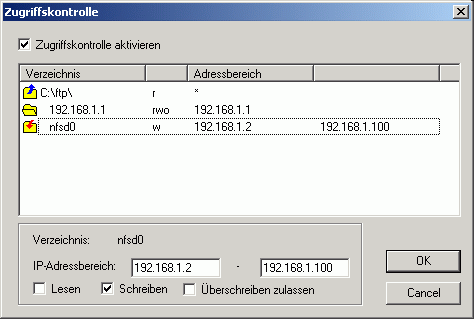
Access control is provided per directory for client IP address and type of
operation.
A native TFTP service is implemented for Windows 200x/XP/Vista/7/8/10.
A Control Panel applet gives interactive access to the service.
Installation
- Requirements
-
Windows 200x/XP/Vista/7/8/10 system configured for TCP/IP
- Installation of the TFTP service on Windows 200x/XP/Vista/7
-
- Install the software by running the setup.
- Use Install TFTP service from the start menu to install the server as service.
- With the control panel applet TFTP Server you can configure and monitor the service.
- Preparation of TFTP Server Application
- Extract the zip-archive, start the application.
Users Guide
The Info Box at startup is displayed only for the unregistered version.
The main windows of the TFTP server displays the status of all active client connections (addresses, progress and type of operation, accessed file).
Running the TFTP server as a Service on Windows 200x/XP/Vista/7
The server can be installed as a service on Windows 200x/XP/Vista/7 for background operation. The service can be configured and monitored by the Control Panel Applet TFTP Server.
- The Service is installed with the command:
TFTP4NT -install
and automatically started on Windows startup. The service can be started and stopped manually through the service control panel. - Use the command
TFTP4NT -remove
to stop and remove the TFTP server service.
- Menus
- File
- Start
- if selected the server accepts new connections.
- Stop
- if selected new connection requests to the server are inhibited. Active connections are not affected.
- View log
- displays a log of all TFTP client requests.
- Exit
- terminates the program
- Options
- Preferences
-
for changing configuration settings.
General
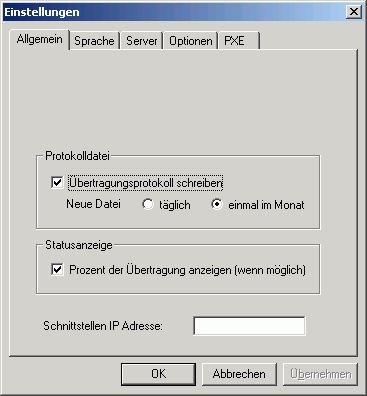
By default the Server is started on all local interfaces. You can restrict the server to one interface only by specifying the local interface IP address.Server
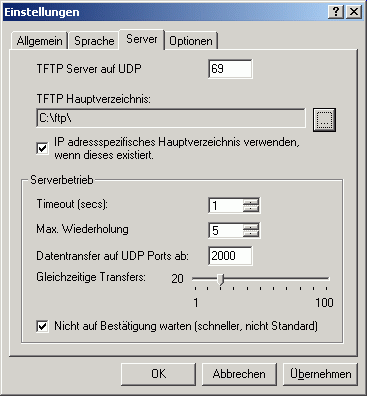
A server root directory must be defined. Any client access outside of the root directory tree is denied. An option enables the server to use a subdirectory of the root directory as a client specific root directory. If this option is enabled and a subdirectory with the IP address of the client exsists, it will be used as the root directory for the client.
The sever allows indicating the range of UDP ports, used for transmitting the data. This allows network administrators to regulate firewall rules, approving the traffic, generated by the server. The UDP port range is defined by specifying the first UDP data port and the number of active clients.Options
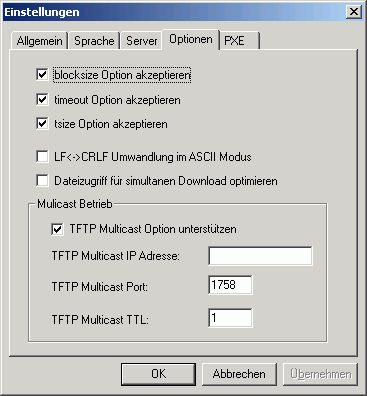
As part of a request TFTP clients can send options to the server. The server can accept or reject the options.- The blocksize option allows the client to choose a data packet size greater than 512 bytes.
- The timeout option allows the client to choose the timeout value for retransmissions. Otherwise the timeout value set on the server will be used.
- With the tsize option the client can inform the server about the total size of the transfered data.
With TFTP Multicast clients can download a file simultanously. The file is sent by the server to the specified multicast address and port. If more than one multicast transfer is started the multicast port number is incremented.PXE
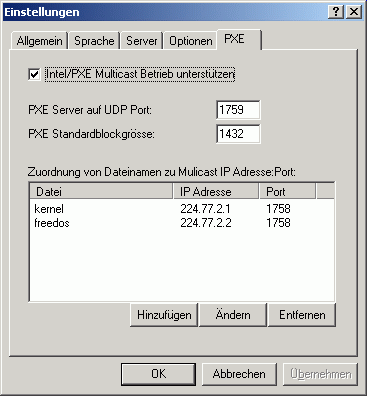
The Intel/PXE specification uses a different protocol for multicast operation. Multicast configuration parameters are sent to clients using DHCP options.- Multicast requests are directed from a client to an extra server port.
- The default blocksize is 1432 bytes.
- Each file downloaded using multicast operation is send to an unique multicast IP address and port.
- Access control
-
Athena Shemale ((full)) Site
Educators, healthcare providers, allies, students of gender studies, and anyone seeking to move from performative support to genuine understanding. It’s also a validating mirror for trans individuals looking for representation that feels real.
The relationship between the transgender community and the broader lesbian, gay, and bisexual subcultures has evolved through collaboration and internal negotiation. While sexual orientation (who you are attracted to) and gender identity (who you are) are fundamentally distinct, these groups found deep solidarity in their shared rejection of rigid societal binaries. Why Are Trans People Part Of LGBT? - TransHub
Culturally, the choice of the name Athena by trans women carries strong symbolic weight. In classical antiquity, the Greek goddess Athena represented a blend of gender attributes . Born directly from the head of Zeus, she embodied supreme intellect and tactical warfare—traditionally male spheres in ancient Greece—while maintaining a female identity. Classical historians frequently note that ancient societies celebrated both her masculine and feminine strengths, making the name a historical symbol of gender fluidity and personal empowerment. athena shemale
To be an ally to the transgender community is to understand that LGBTQ culture did not exist before the T and simply add it on. The T was there at the riot, in the hospital wards during the plague, and on the front lines of the culture war. The rainbow flag flies because of the courage of trans people. Defend them, and you defend the entire spectrum of human possibility. Abandon them, and you are left not with a rainbow, but with a faded, monochrome shadow of a movement that lost its soul.
The word "shemale" originated within the adult entertainment industry. It was used as a genre-specific descriptor for a transgender woman, often one who had not undergone gender-affirming surgery. The term was a crude, literal blend of "she" and "male," designed to categorize performers in a way that was easily searchable for a particular niche of content. In the Russian Wikipedia entry for the term, it explicitly states that “the word ‘shemale’ (English for ‘she’ + ‘male’) came from the porn industry, when transgender women first appeared there, showing both a female body, breasts, and an erect penis”. While sexual orientation (who you are attracted to)
Three years before the famous events in New York, transgender women and drag queens in San Francisco’s Tenderloin district stood up against systemic police harassment. The riot at Gene Compton’s Cafeteria marked one of the first recorded instances of collective, physical resistance to the oppression of queer people in United States history. It directly led to the creation of a network of trans-led social, psychological, and medical support services. The Stonewall Inn (1969)
Ballroom culture, famously documented in the film Paris Is Burning and celebrated in the television series Pose , served as a mutual-aid network and a competitive arena. Terms used widely today—such as "spilling tea," "throwing shade," "vogueing," and "reading"—were created by trans and queer people of color in these spaces. In classical antiquity, the Greek goddess Athena represented
The consolidation of "LGBT" (and later LGBTQ+) as a cohesive political alliance gained momentum in the late 20th century. Activists recognized that while sexual orientation (who you are attracted to) and gender identity (who you are) are fundamentally different, both groups faced the same systemic enemy: rigid, heteronormative societal expectations. Including the "T" unified the communities under a broader banner of gender and sexual diversity. Cultural Contributions and the Language of Pride
As we move forward in our understanding of human identity and expression, it's essential to approach these topics with empathy, respect, and an open mind. By exploring the intersection of mythology and contemporary issues, we can gain a deeper understanding of ourselves and the world around us.
- Help
- Contents
- starts a HTML browser displaying the manual.
- Register
- prompts for the license key and your name, company. Check the Info menu to find out if the license information was accepted.
- Show License
- displays the conditions for using this software.
- About...
- displays program version information.
Using the TFTP Client
TFTP.EXE is a Win32 command line TFTP client.The implementation of the client as a command line program allows easy use of the client for automated tftp data transfer from application or procedures.
Usage: tftp [Options] server GET|PUT file [local]
- server: IP address or name of the TFTP server
- file: Name of file to transfer
- local: Local name of file
- Options:
- -a mode ASCII, default OCTET
- -b<blocksize> block size in bytes, default 512
- -d write debug messages
- -l show transfer activity
- -o override if local file exists
- -p pipe: send data from stdin/receive data to stdout
- -r<retries> number of retries on timeout
- -s disable transfer size option, default enabled
- -t<timeout> retransmission timeout in seconds, default 1s